Leading Innovation through Materials Informatics
Accelerating materials development through property prediction, materials mapping, autonomous chemical experimentation, and multi-agent AI-driven data analysis.

What is Materials Informatics?
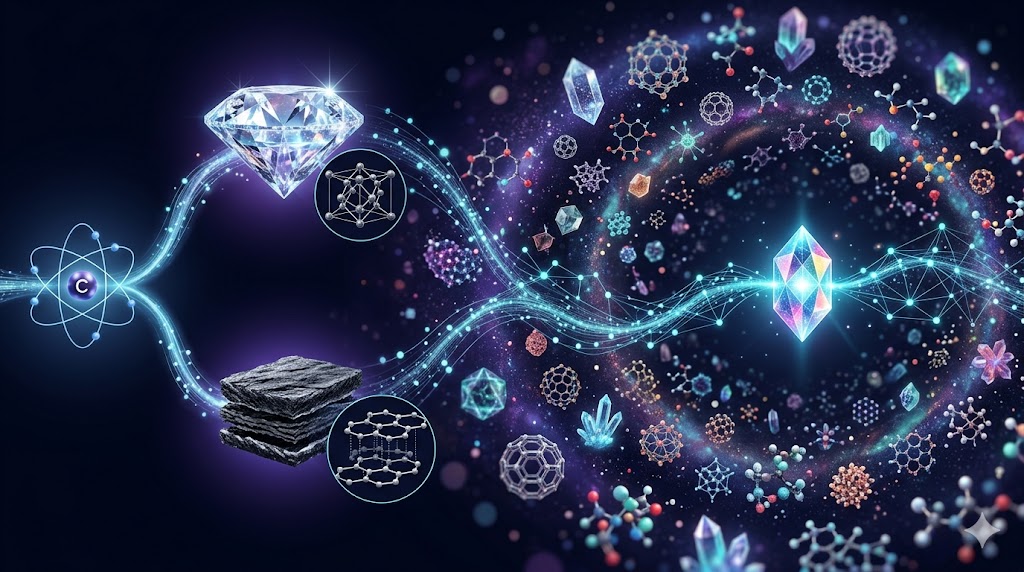
Materials are all around us. Every material is made of atoms, and the number of possible combinations is enormous. Moreover, just as diamond and pencil lead are both made of the same carbon atoms, a material's properties depend strongly on its atomic structure. As a result, the space of possible materials is, for all practical purposes, virtually infinite.
Materials development is the task of choosing the single best option from this near-infinite space. Traditionally it has relied on the intuition of seasoned experts; Materials Informatics is the attempt to tackle this hard problem with data-science methods.
Profile
Research Areas
Four focused themes in materials informatics — from property prediction to autonomous experimentation
Materials Property Prediction
Predicting materials properties at high throughput with graph neural networks and machine learning, narrowing vast candidate spaces to the promising few.
Learn the methods →Materials Map Development
Mapping the materials space (e.g., t-SNE colored by predicted properties) to grasp distributions and trends at a glance.
Try the interactive map →Autonomous Chemical Experimentation
Closing the loop with robotic synthesis, automated measurement, and Bayesian optimization for round-the-clock experiments.
View research →Multi-Agent Autonomous Data Analysis
Orchestrating multiple LLM agents to autonomously analyze, interpret, and report on research data.
Learn about AI agents →AI Terakoya
Comprehensive video learning platform for data-driven R&D
Covering Materials Informatics, Materials Science, Process Informatics, and Machine Learning with comprehensive video tutorials.
Selected Publications
AI-Driven Materials Mapping
Y. Hashimoto, X. Jia, H. Li, T. Tomai
APL Machine Learning 3, 036104 (2025)
All-Optical Observation of Spin Wave Dispersion
Y. Hashimoto, S. Daimon, R. Iguchi, et al.
Nature Communications 8, 15859 (2017)83+ citations
Photo-Induced Magnetization Precession
Y. Hashimoto, S. Kobayashi, H. Munekata
Physical Review Letters 100, 067202 (2008)100+ citations
Room Temperature Spin Seebeck Effect Enhancement
R. Ramos, T. Hioki, Y. Hashimoto, et al.
Nature Communications 10, 5162 (2019)
Macrospin Dynamics in Antiferromagnets
D. Bossini, S. Dal Conte, Y. Hashimoto, et al.
Nature Communications 7, 10645 (2016)
Keynote Lecture at IMPRES2025
Hashimoto Y.
4th International Symposium on Powder Metallurgy (October 2025)
Mapping Thermoelectric Materials Using Machine Learning